The 1940s were a decade when clothing had to serve real life. Fashion was still about looking good, but war, shortages, changing jobs, and shifting social expectations affected what people could buy and what they actually needed to wear. A smart outfit often depended less on owning something new and more on making a few well-chosen pieces work harder. The decade also changed considerably from beginning to end. Early styles favored firm shoulders, tidy skirts, practical dresses, and restrained details. As the post-war years arrived, designers began introducing softer shapes, longer hemlines, and fuller skirts. That contrast gives 1940s fashion much of its character.
Women’s 1940’s Fashion
Women’s wardrobes balanced appearance with usefulness. Dresses and skirt suits remained everyday standards, but the shapes were generally clean and controlled. Jackets often emphasized the shoulders, while belts or fitted seams brought definition to the waist. A woman didn’t necessarily need an elaborate wardrobe to look well dressed. A blouse could be paired with different skirts, while a jacket could give a simple dress a more formal appearance. Accessories helped stretch those combinations further, which mattered during years when replacing clothes wasn’t always easy. Colors and prints prevented practical clothing from becoming completely severe. Checks, stripes, florals, and other patterns appeared alongside plain fabrics. The result was a style that could feel cheerful even when the construction itself was relatively straightforward.
Dresses for Work and Everyday Life
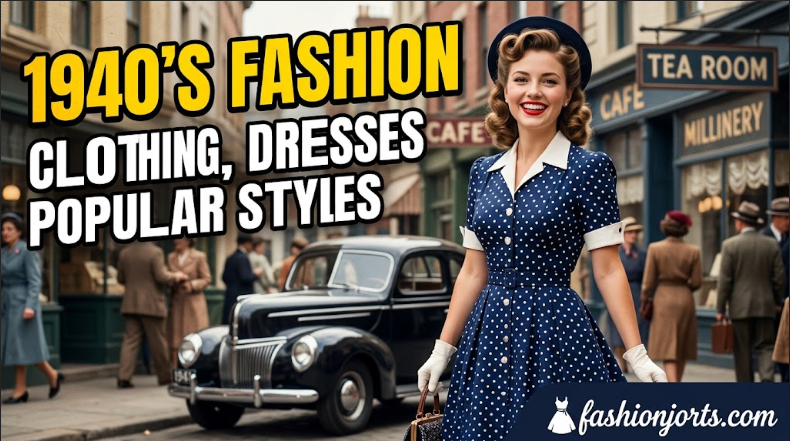
Day dresses were designed to be wearable rather than extravagant. Button fronts, collars, short or elbow-length sleeves, and defined waists created a neat appearance without making the garment difficult to move in. Skirts generally allowed enough freedom for ordinary daily activities while avoiding unnecessary fullness. Shirt dresses became a natural fit for this approach. Their familiar shirt-like upper section made them easy to wear, while a belt could create shape without complicated tailoring. Depending on the fabric and accessories, the same basic idea could work for shopping, visiting friends, or going to work. More formal dresses could introduce softer fabrics and decorative details. Evening clothing allowed greater experimentation than practical daytime outfits, although the availability of materials still mattered. Fashion never disappeared during difficult years; it simply operated within different limits.
Tailored Suits Created a Strong Silhouette
The women’s suit became one of the decade’s most recognizable outfits. Jackets often had pronounced shoulders, neat lapels, and a fitted middle, producing a confident shape. A coordinating skirt kept the overall appearance polished without requiring excessive decoration. This style worked particularly well because individual pieces could be reused. A jacket didn’t always have to stay with its matching skirt, and a blouse could change the character of the outfit. Building combinations from a smaller wardrobe made practical sense. Military clothing also influenced the visual language of civilian tailoring. Strong shoulders, orderly lines, functional pockets, and restrained decoration all suited the mood of the early decade. The influence was visible without every suit literally resembling a uniform.
Women Made Trousers Part of Practical Dressing
Trousers became increasingly visible on women, particularly where work demanded freedom of movement. Factory and agricultural jobs made practical clothing essential, and slacks or coveralls were often better suited to physical tasks than skirts. Workwear had to protect the wearer as well as allow her to move comfortably. The change didn’t mean that trousers immediately became acceptable for every occasion. Social expectations still favored dresses and skirts in many public and formal settings. Pants occupied a more practical and casual place in the wardrobe. Their increased visibility still mattered. Once women regularly wore trousers for necessary work, they became harder to dismiss as unusual clothing. The 1940s helped move them further toward the everyday womenswear they would eventually become.
Hairstyles Completed the 1940s Look
Hair could make a relatively simple outfit appear carefully finished. Women often wore curls, waves, rolls, and pinned arrangements that kept the hair shaped around the face. Victory rolls became especially memorable, though they represented only one of many styles worn during the period. Practicality influenced hair as well. Women working around equipment needed to prevent loose hair from becoming a hazard, making scarves, turbans, and other coverings useful. These pieces could still be arranged attractively rather than treated purely as protective gear. Makeup added another layer of polish. Defined brows and noticeable lipstick suited the clean lines of contemporary hairstyles and clothing. Beauty routines provided a relatively accessible way to change an appearance even when buying a new outfit wasn’t realistic.
Accessories Made Simple Outfits More Versatile
Hats remained an important finishing touch, appearing in numerous shapes rather than one standard design. Some were small and structured, while others used decorative details to draw attention upward. A hat could instantly make a familiar suit or dress look more formal. Gloves and handbags also remained part of a well-dressed appearance. Belts were particularly effective because they reinforced the defined waist seen throughout much of women’s clothing. Scarves could add pattern or contrast without requiring much material. Jewelry was often most effective when used selectively. Brooches, earrings, necklaces, and dress clips could bring interest to otherwise restrained clothing. The emphasis was frequently on one noticeable detail rather than covering an outfit with decoration.
Shoes Had to Balance Style and Practicality
Footwear reflected the same practical concerns found elsewhere in the wardrobe. Pumps and sturdy everyday shoes worked with both dresses and suits, while heel shapes varied according to occasion. Shoes needed to survive regular use, making practicality more than a minor consideration. Material shortages encouraged experimentation. Conventional shoe materials weren’t always readily available, so manufacturers sometimes turned to alternative components and construction methods. This produced footwear that could look stylish while responding to the realities of production. Shoes also helped determine how an outfit felt. A practical daytime pair could make a dress suitable for work, while a more refined heel could prepare similar clothing for an evening occasion. Versatility remained valuable throughout the decade.
Men’s Style Stayed Smart but Practical
Suits continued to occupy an important place in men’s civilian wardrobes. Jackets maintained structured shoulders, while shirts and ties preserved the formal appearance expected in professional and social settings. Wartime conditions, however, discouraged unnecessary use of cloth. Casual wardrobes were becoming more varied as well. Sweaters, open-collar shirts, sports jackets, and practical trousers gave men options outside the traditional matching suit. These styles hinted at the increasingly relaxed approach to menswear that would develop after the war. Military service inevitably influenced men’s appearance during the decade. Uniforms were visible everywhere, and their practical construction reinforced a broader preference for disciplined shapes. That influence remained recognizable even after servicemen returned to civilian clothing.
Children’s Clothing Focused on Durability
Children’s clothes needed to withstand frequent wear, especially when households couldn’t easily replace garments. Dresses, shirts, shorts, sweaters, trousers, and coats were often straightforward in construction. Durability mattered because clothes might also be passed from one child to another. Girls’ clothing often reflected adult styles in simplified form. Fitted dresses, collars, pleated skirts, and cardigans created tidy outfits without the stronger tailoring found in women’s suits. Boys commonly wore shorts or trousers with shirts, knitwear, and jackets. Repairing children’s clothes was a normal part of extending their usefulness. Growing children presented an obvious challenge when materials and household budgets were limited. Practical construction therefore mattered just as much as appearance.
The Late 1940s Brought a New Shape
As the decade moved beyond the war, fashion began turning away from the compact wartime silhouette. Skirts grew longer and fuller, shoulders became less severe, and the waist received even greater emphasis. Clothing started to use volume as a visible part of its appeal. Christian Dior’s 1947 collection became the most famous expression of this direction. The style associated with his New Look featured rounded shoulders, a closely shaped waist, and generous skirts. It felt dramatically different from clothing designed around wartime economy. The transition wasn’t immediate for ordinary wardrobes. New couture trends didn’t mean everyone suddenly discarded useful clothing, particularly where shortages and financial pressures remained. Fashion changed gradually as new silhouettes moved from designer collections into more accessible clothing.
Why the Decade Still Inspires Modern Fashion
Many individual elements from the period translate easily into contemporary wardrobes. High-waisted trousers, fitted jackets, midi skirts, shirt dresses, structured coats, and carefully defined waists can reference the era without creating a head-to-toe historical costume. That makes the decade particularly adaptable for vintage-inspired dressing. Modern styling also shows why separating early and late 1940s influences is useful. Strong shoulders and straighter skirts suggest the wartime years, while a narrow waist paired with a sweeping skirt points toward the later part of the decade. Knowing the difference creates a more convincing result. The broader appeal comes from how carefully these clothes were shaped. Even practical garments relied on proportion and thoughtful construction to create their effect. That combination of function and polish remains relevant well beyond vintage fashion.
Conclusion
Clothing in the 1940’s fashion wasn’t static. It changed alongside work, material availability, social expectations, and the transition from war to peace. Practicality influenced the decade without removing people’s desire to dress with care. The strongest wartime styles found character through tailoring rather than excess. Suits, dresses, work trousers, accessories, and carefully arranged hairstyles allowed people to look polished while working with limited wardrobes. Those qualities give early-decade clothing its unmistakable identity. Late in the decade, designers offered a different vision built around length, volume, and a tightly shaped waist. That change created a bridge toward the fashions commonly associated with the 1950s. Looking at both periods gives a much clearer picture of what 1940s style actually meant.