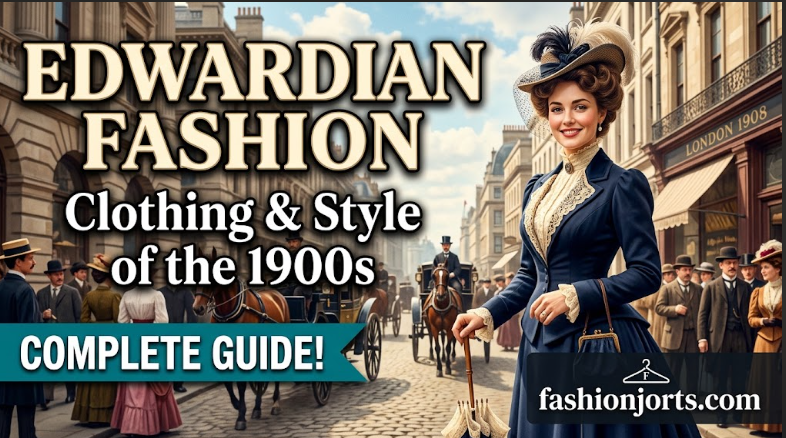
Edwardian fashion belonged to an age caught between two very different ideas of dress. The formality of the Victorian period had not disappeared, but clothing was beginning to respond to changing social habits, greater mobility, and new ideas about comfort. The result was a distinctive style built around elegant shapes, careful tailoring, decorative fabrics, and highly visible accessories. The period takes its name from King Edward VII, who ruled Britain from 1901 to 1910. Fashion historians often discuss the years surrounding his reign as part of the same broader style because clothing did not change overnight when one monarch succeeded another. During these years, women’s silhouettes changed considerably, while men’s clothing developed in quieter but still important ways.
What Is Edwardian Fashion?
Edwardian clothing is generally associated with the first decade of the twentieth century. Early styles still carried many features of late Victorian dress, including long skirts, fitted waists, formal men’s suits, and clearly defined expectations about what people should wear for different occasions. What makes the period interesting is the speed of change. At the beginning of the 1900s, fashionable women’s clothing created an exaggerated curved figure. By the early 1910s, designers were moving toward straighter shapes that looked noticeably more modern. Social class also influenced dress. Wealthy people could afford expensive fabrics, custom-made garments, and different outfits for particular social events. Working people generally needed clothing that could withstand everyday use, so the luxurious outfits preserved in museums shouldn’t be viewed as a complete picture of how everyone dressed.
What Did Edwardian Women Wear?
A fashionable woman’s wardrobe could include long dresses, separate skirts and blouses, tailored jackets, evening gowns, coats, and clothing designed for specific activities. Day dresses usually covered much of the body, with high necklines, long sleeves, and skirts reaching close to the floor. Decoration was a major feature of expensive clothing. Lace, embroidery, pleats, ribbons, and carefully arranged fabric gave dresses visual depth without relying on bright or excessive decoration everywhere. The finest garments could require considerable skill to construct. Evening clothes followed different expectations. Necklines could be much lower, and formal gowns might leave the shoulders and arms exposed. Gloves, jewelry, and carefully arranged hair completed an appearance designed specifically for dinners, dances, theatres, and other formal occasions.
The S-Bend Silhouette and Edwardian Corsets
The S-bend silhouette became one of the most recognizable features of early Edwardian womenswear. Rather than creating a completely upright figure, the fashionable shape made the chest appear to project forward while the hips extended backward. Corsets helped produce this profile, but the outer clothing strengthened it. Blouses often contained extra material around the chest, while skirts were shaped to balance the lower body. Seen from the side, the finished figure could resemble a gentle S. This style also shows how carefully women’s clothing was constructed around an ideal body shape. The appearance wasn’t simply created by the wearer’s natural figure. Underwear, padding, garment construction, and posture all contributed to the final result.
Edwardian Dresses, Skirts, and Blouses
Long skirts were central to women’s dress. Earlier examples tended to have greater fullness toward the hem, creating movement while preserving the narrow-looking waist expected in fashionable clothing. Formal gowns could also include trains that extended behind the wearer. Blouses offered greater flexibility. The popular shirtwaist could be worn with a separate skirt, allowing a woman to create different combinations without purchasing an entirely new outfit. Some were relatively plain, while others featured lace, pin tucks, embroidery, or decorative collars. Tailored clothing provided another alternative to elaborate dresses. Jackets and matching skirts produced a cleaner appearance suitable for travel, shopping, work, and other daytime activities. These garments also reflected the gradual move toward clothing designed around increasingly active lifestyles.
Edwardian Hats, Shoes, and Accessories
Few accessories represented the period as dramatically as women’s hats. Fashionable hats could be exceptionally wide and decorated with flowers, ribbons, feathers, or fabric. Their size also worked visually with the elaborate hairstyles popular at the time. Footwear was generally less conspicuous because long skirts covered much of the shoes. Boots were practical for daytime wear, while more delicate shoes could accompany evening clothes. Designs varied according to season, activity, and social setting. Gloves, parasols, small bags, jewelry, and belts could finish an outfit. These details weren’t chosen randomly. Dress conventions meant that an accessory considered suitable for an afternoon visit might not be appropriate for a formal evening event.
What Did Edwardian Men Wear?
Men’s clothing was generally more restrained than women’s fashion. Suits formed the foundation of many wardrobes, particularly among middle- and upper-class men. Jackets, trousers, waistcoats, shirts, and ties created the structured appearance associated with the period. The occasion determined the level of formality. Business and everyday social activities called for different clothing from formal dinners or important daytime ceremonies. Evening dress could include a dark tailcoat and formal accessories, while less formal suits became increasingly useful for ordinary life. Hats remained an expected part of public dress. Top hats suited highly formal occasions, while bowlers, flat caps, and straw boaters served different social groups and situations. Men’s clothing therefore communicated occupation, status, setting, and formality even when the basic garments appeared similar.
How Social Class Influenced Edwardian Clothing
The glamorous image of the period largely comes from wealthy households, society portraits, fashion illustrations, and surviving luxury garments. That image can be misleading if it is treated as universal. Upper-class women could change clothes several times during a busy day. Their wardrobes might contain separate garments for morning activities, afternoon visits, dinners, sporting events, travel, and major social occasions. Maintaining those standards required both money and domestic labor. Working-class wardrobes were shaped more strongly by durability and cost. Clothes might be repaired, altered, reused, or passed between family members. Fashion still mattered, but following every new style wasn’t realistic for households with limited income.
Sports and the Rise of More Practical Clothing
Changes in leisure helped push clothing toward greater practicality. Cycling, golf, tennis, walking, and other outdoor activities created situations where highly restrictive dress could become inconvenient. Women did not suddenly abandon conventional clothing. Instead, garments were gradually adapted to particular activities, giving wearers greater freedom while remaining socially acceptable. Tailored jackets, practical skirts, sturdy footwear, and simpler blouses became useful parts of active wardrobes. These changes mattered beyond sport itself. They showed that clothing could respond to what women were actually doing rather than existing only to create a fashionable silhouette.
How Edwardian Fashion Changed After 1907
By the later years of the decade, the dramatic S-shaped figure was losing its position at the center of fashion. Silhouettes became slimmer, waists appeared higher in some designs, and skirts increasingly followed a straighter line. The change wasn’t immediate or universal. Older and newer styles existed at the same time, just as they do today. A fashionable woman might adopt a newer silhouette while someone else continued wearing clothes influenced by earlier years. Still, the overall direction was clear. Women’s high fashion was moving away from the heavily shaped body associated with the opening years of the century and toward the longer, narrower forms of the 1910s.
Paul Poiret and the Move Toward Modern Fashion
French designer Paul Poiret became closely associated with this shift. His designs often relied on draping and straighter lines rather than the strongly corseted shape that had dominated women’s fashion. Some of his clothes drew attention to a higher waist and a more column-like body. These ideas looked strikingly different from the curved profile fashionable only a few years earlier and helped establish Poiret as one of the era’s best-known designers. But new did not always mean practical. The narrow hobble skirt associated with early 1910s fashion could restrict walking despite belonging to a period that was moving away from older corsetry. Fashion history rarely follows a simple path from restrictive clothing to comfortable clothing.
Edwardian Fashion vs. Victorian Fashion
The boundary between Victorian and Edwardian clothing is less precise than the names suggest. Late Victorian styles continued into the new century, and several ideas associated with Edwardian dress had already appeared during the 1890s. The difference becomes clearer across a longer timeline. Victorian fashion went through bustles, changing sleeve shapes, tightly structured dresses, and several distinct silhouettes. Early Edwardian style developed the characteristic S-curve before moving toward slimmer forms. Edwardian clothing is therefore best understood as a transition rather than a complete break with the past. It inherited nineteenth-century standards of formality while introducing shapes and practical changes that pointed toward twentieth-century dress.
Why Edwardian Fashion Still Influences Style Today
Modern designers continue to revisit features associated with the period. High collars, lace blouses, long flowing skirts, puffed sleeves, tailored jackets, and decorative detailing can all return without recreating an entire historical outfit. Period dramas and historical-inspired fashion have also kept the look recognizable. Yet modern interpretations usually remove the restrictive foundations and strict social rules that originally shaped these garments. That distinction matters. Edwardian-inspired clothing can borrow the visual language of the period while adapting it to modern expectations of comfort and movement.
Conclusion
Edwardian fashion deserves attention for more than its lace dresses and dramatic hats. It captures a period when older rules of appearance remained powerful but were becoming harder to separate from changing lifestyles. The contrast is clearest in women’s dress. Within a relatively short period, the fashionable figure moved from an exaggerated corseted curve toward a longer and straighter shape, while practical separates and tailored clothing became increasingly useful. Men’s wardrobes changed more quietly, yet the growing importance of familiar suit forms also points toward modern clothing. Both sides of fashion history show a society balancing tradition with new expectations. Seen in that context, Edwardian clothing becomes much easier to understand. Rather than a single frozen style, it was a period of transition that connected nineteenth-century formality with the rapidly changing fashions of the twentieth century.