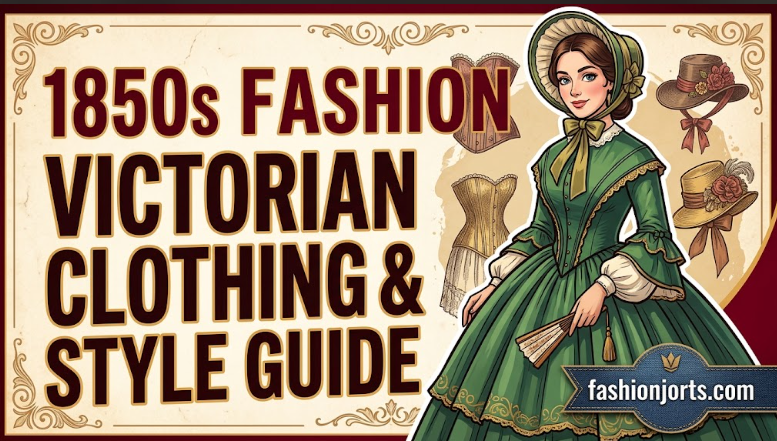
The 1850s produced one of the most recognizable periods of Victorian dress. Women’s skirts spread outward into broad, rounded shapes, while fitted bodices and carefully arranged sleeves created a strong contrast above the waist. Men’s clothing was quieter but still formal, built around coats, waistcoats, trousers, crisp shirts, and structured hats. Yet the decade wasn’t defined by appearance alone. Clothing construction was changing, new manufacturing methods were becoming more important, and the arrival of the cage crinoline altered the way fashionable dresses were worn. Looking at the decade from beginning to end reveals a style in transition rather than one fixed Victorian look.
What Did 1850s Fashion Look Like?
The most obvious feature of women’s clothing was proportion. A close-fitting bodice sat above a skirt that widened toward the floor, creating the rounded outline associated with mid-Victorian dress. Sloping shoulders softened the upper body, making the skirt appear even larger by comparison. Decoration could be generous without following a single formula. Dresses appeared with stripes, floral patterns, contrasting trims, lace, fringe, and rows of fabric ornament. Wealth, occasion, age, and practical needs all affected how closely an individual followed fashionable ideals. Men presented a narrower and more restrained silhouette. Their wardrobes relied on layers, with a shirt and waistcoat worn beneath a coat and trousers completing the main outfit. Differences in fabric, cut, pattern, and accessories allowed men to adjust their appearance according to formality.
Women’s Fashion in the 1850s
Fashionable women’s dress depended heavily on shape. Bodices followed the torso closely while skirts provided most of the visual volume, producing a waist that looked particularly narrow in comparison. The effect was created by the whole outfit rather than by any single garment. Daytime clothing generally provided greater coverage than evening dress. High necklines and long sleeves suited everyday social settings, while formal gowns could reveal the shoulders and upper chest. Changing the fabric and decoration allowed the same broad silhouette to work for very different occasions.
The Bell-Shaped Skirt
At the start of the decade, women relied heavily on petticoats to give skirts their desired fullness. As fashionable skirts grew wider, more support was required underneath. This added bulk and could make an already substantial outfit heavier. The preferred outline remained rounded rather than sharply projected at the back. Fabric spread around the wearer and fell toward a broad hem, creating the characteristic bell or dome shape. By the end of the decade, this silhouette had become far more dramatic than it was around 1850.
Fitted Bodices and Defined Waists
The bodice provided a visual counterpoint to the expanding skirt. It was closely fitted and usually met the skirt around the natural waist as the decade progressed. Corsetry supported the torso underneath, while the width below made the waist appear smaller. This proportion explains why period portraits can sometimes give an exaggerated impression of waist size. A narrow-looking middle was surrounded by carefully shaped shoulders and an exceptionally broad skirt. Understanding that visual relationship gives a more accurate picture than focusing on corsets alone.
Pagoda Sleeves and Undersleeves
Wide sleeves became one of the decade’s most recognizable details. Pagoda sleeves opened as they descended from the arm, creating a flared shape that complemented the width of the skirt. They could be relatively restrained or large enough to become a major feature of the dress. White undersleeves were often visible beneath these open sleeves. Lace, embroidery, and delicate fabric brought contrast to heavier dress materials and could be changed separately. This combination allowed women to add detail without redesigning an entire gown.
The Rise of the Cage Crinoline
Few developments affected the appearance of Victorian clothing as visibly as the cage crinoline. Before it became available, women depended largely on fabric layers and stiffened petticoats to create fashionable volume. Increasing skirt size made that approach progressively less convenient. The cage offered another solution. Hoops formed a framework beneath the dress, holding the skirt away from the legs and preserving its rounded shape. Women could therefore achieve greater width without relying on the same quantity of heavy fabric underneath.
What Women Wore Before the Cage Crinoline
Petticoats were essential during the early part of the decade. Several could be layered together, while stiffer materials helped prevent the outer skirt from collapsing around the legs. The method produced the desired shape but added considerable fabric to an outfit. Women still needed appropriate underlayers after hoops became fashionable. The difference was that the structural work could increasingly be performed by the cage rather than by stacked petticoats alone. This helped make larger skirts practical enough to become a defining fashion.
How the 1856 Crinoline Changed Fashion
The cage crinoline appeared in 1856 and quickly influenced fashionable dress. Its framework supported the skirt directly, allowing designers and wearers to experiment with greater circumference. Late-1850s dresses could therefore achieve proportions that would have been cumbersome using fabric layers alone. There were obvious drawbacks. A very wide skirt required space when walking, sitting, or passing through narrow areas, and its movement had to be managed carefully. Still, the crinoline’s popularity shows that wearers saw advantages in the new structure despite its inconveniences.
Day Dresses and Evening Gowns
Victorian dress changed according to the setting. A daytime gown typically covered the shoulders and chest and was suitable for visits, walking, or other daytime activities. Fabrics and decoration ranged from practical and restrained to expensive and highly ornamental. Evening clothing allowed a different presentation. Necklines became lower, shoulders could be exposed, and sleeves were often shorter than those used during the day. Silk, lace, ribbons, and decorative trimmings could make formal gowns particularly elaborate. The underlying fashionable proportions remained recognizable in both settings. What changed most was the amount of coverage, the richness of the material, and the type of ornament used. This distinction helped clothing communicate where and when it was appropriate to wear.
Fabrics, Colors, and Decorative Details
Victorian fashion is sometimes imagined as overwhelmingly dark, but 1850s wardrobes could contain substantial color and pattern. Stripes, checks, floral designs, and contrasting combinations appeared alongside solid fabrics. Silk was especially suited to expensive dresses, while cotton and wool served a wide range of everyday purposes. Trimming gave dressmakers another way to change the appearance of a garment. Lace, braid, fringe, ribbons, pleats, and fabric flounces could draw attention to sleeves, bodices, or the enormous surface of a skirt. Some gowns were richly decorated, while others depended on an attractive textile rather than layers of ornament. Color possibilities also began changing during the decade. The emergence of early synthetic dyes pointed toward brighter and more commercially reproducible shades. Their greater impact would become visible as dye technology expanded during the following years.
Hairstyles, Bonnets, and Accessories
Women often wore their hair with a center part and smooth sections arranged toward the sides and back of the head. Rather than adding great height, these hairstyles generally remained controlled and close enough to work beneath fashionable headwear. The result complemented the broad horizontal emphasis created by dresses. Bonnets remained important for outdoor clothing and framed the wearer’s face closely. Ribbons secured them beneath the chin, while flowers, fabric, lace, or other decorations could make them more elaborate. Their appearance varied considerably according to occasion and personal means. Shawls, gloves, jewelry, parasols, and small personal accessories completed fashionable outfits. Large shawls worked especially well with broad skirts because they could fall across the shoulders without competing with a tightly fitted coat. Accessories also offered a practical way to vary an existing wardrobe.
Men’s Fashion in the 1850s
Men’s clothing relied less on dramatic changes in width, but tailoring remained important. The frock coat was a familiar choice for respectable daytime dress, extending well below the waist and creating a long, controlled outline. Waistcoats and trousers completed the layered appearance. Men were not limited to entirely dark clothing. Waistcoats could introduce pattern and color, while trousers appeared in checks, stripes, and plain fabrics. The appropriate combination depended on whether a man was dressing for business, leisure, visiting, or a formal evening occasion.
Frock Coats, Waistcoats, and Trousers
The frock coat helped define respectable mid-century menswear. Its fitted upper section and longer skirt gave it a more formal appearance than shorter jackets. Different coats could be selected as the occasion became more or less formal. A waistcoat occupied the space between shirt and coat and provided an opportunity for greater visual variety. Trousers were generally long and increasingly comfortable in cut compared with tightly fitted styles from earlier periods. Together, these pieces created a wardrobe that could be adjusted without changing its basic structure.
Men’s Hats and Accessories
A properly dressed man often completed his outfit with a hat. The top hat remained strongly associated with respectable and formal clothing, although other shapes suited less formal situations. Headwear was therefore both practical and socially meaningful. Neckwear was another important detail. Cravats and ties brought attention to the collar and could change the character of otherwise similar clothing. Gloves, watches, walking sticks, and other personal items added finishing touches when the occasion called for them.
How Technology Changed 1850s Fashion
The decade coincided with changes in clothing production that extended beyond style. Sewing machines were becoming increasingly useful for manufacturing, reducing the amount of work that had to be completed entirely by hand. Fashionable goods could be produced more efficiently as industrial methods developed. The crinoline itself reflected this shift. A fashionable silhouette could now depend on a manufactured framework rather than simply additional layers of handmade clothing. Dressmaking remained skilled work, but technology was becoming more visible throughout the process.
Sewing Machines and Clothing Production
Machine sewing didn’t instantly replace hand sewing. Many garments continued to involve substantial hand finishing, especially where precise fitting or decorative work was required. The machine instead became another tool that could speed up suitable parts of construction. Over time, faster production helped reshape the clothing trade. Manufacturers could make certain garments and undergarments in larger quantities, while dressmakers could combine machine and hand techniques. The foundations of a more industrial fashion system were becoming clearer.
The Arrival of Synthetic Dyes
Another major development came from chemistry. William Henry Perkin discovered the purple dye later associated with mauve in 1856, providing an early breakthrough in synthetic textile color. Natural dyes remained important, but artificial alternatives opened possibilities that would expand rapidly. The change was larger than one fashionable shade. Synthetic chemistry eventually made brilliant colors easier to reproduce commercially, influencing both textile manufacturing and consumer taste. The 1850s therefore stand close to the beginning of a major shift in how fashionable color was created.
Early 1850s vs. Late 1850s Fashion
A dress from 1850 doesn’t necessarily look the same as one from 1859. Earlier skirts were already full, but their volume was generally more restrained and depended heavily on petticoats. Elements inherited from the previous decade were still visible in bodice construction and overall proportions. Late in the decade, the silhouette had become unmistakably larger. Cage-supported skirts spread farther from the body, wide sleeves remained fashionable, and decoration could emphasize the growing scale of the garment. These changes led directly toward the enormous round skirts associated with the early 1860s.
Was 1850s Fashion the Same for Everyone?
The most spectacular surviving dresses can distort our understanding of everyday clothing. Museum collections, fashion illustrations, and formal portraits often preserve styles connected with people who had the resources and reasons to dress fashionably. A working wardrobe had different requirements from an evening gown worn in an elite social setting. Income, occupation, age, climate, and location all affected what people wore. Someone could follow a fashionable silhouette in a simpler fabric, reuse an older garment, or adopt only selected new details. Victorian society had recognizable fashion trends, but it didn’t dress from a single wardrobe. This distinction matters when recreating historical clothing. Accuracy depends on deciding who the wearer is, where they live, what they are doing, and what they can afford. Choosing the most extravagant surviving gown isn’t automatically the most authentic option.
Conclusion
The appeal of 1850s fashion lies partly in its proportions. A fitted upper body surrounded by widening sleeves and an enormous rounded skirt created a silhouette that can often be recognized immediately. Men’s clothing provided a more restrained counterpart through tailored coats, waistcoats, trousers, and formal accessories. The arrival of the cage crinoline in 1856 accelerated a change already underway. Skirts could expand without depending entirely on increasingly heavy layers of petticoats, and the late-1850s silhouette became much larger than the one seen at the beginning of the decade. At the same time, clothing production was changing behind the scenes. Machine sewing and synthetic dyes pointed toward a fashion industry increasingly connected with manufacturing and chemistry rather than traditional hand production alone. For modern readers, costumers, and fashion-history enthusiasts, the best way to understand the period is to look beyond the largest ball gowns. Consider the wearer, occasion, construction, and year, and the 1850s become a much richer period than the familiar image of a Victorian woman in a hoop skirt.