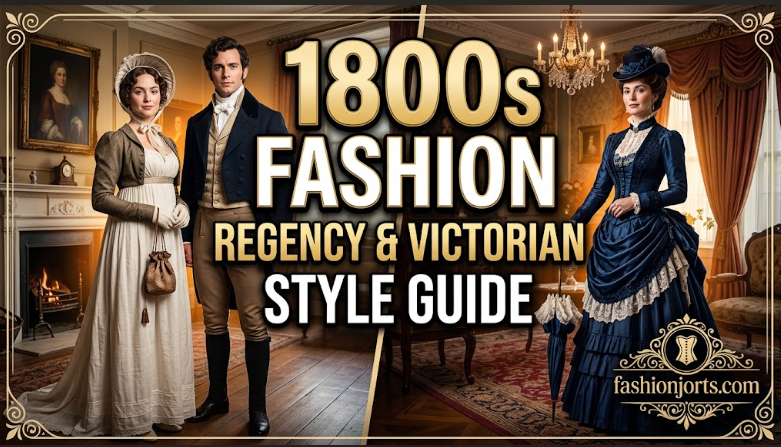
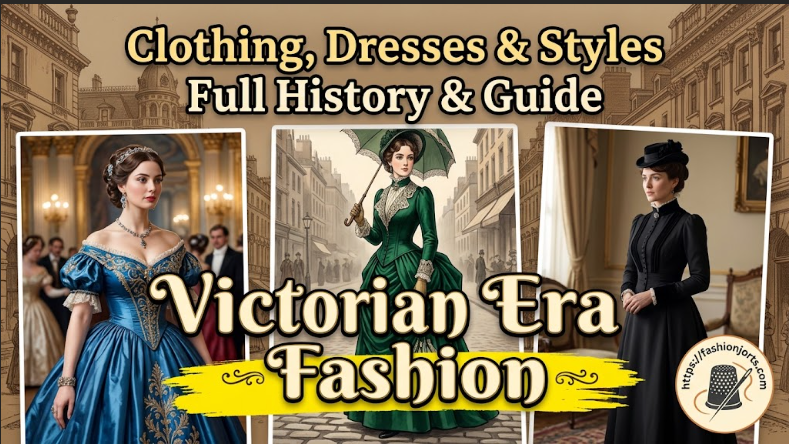
Victorian era fashion covered more than six decades of changing tastes, from the beginning of Queen Victoria’s reign in 1837 to her death in 1901. Although people often picture corsets and huge dresses when they think of this period, clothing changed dramatically from one generation to the next. Skirts grew wider, moved outward at the back, and eventually became slimmer again, while men’s clothing developed its own rules around tailoring and formality. Fashion also said a great deal about Victorian society. Wealth, occupation, gender, and occasion could influence what someone wore and how elaborate that clothing could be. New manufacturing methods made some fashionable items easier to produce, while changing attitudes toward women’s activities helped encourage more practical styles toward the end of the century.
What Was Victorian Era Fashion?
Victorian fashion refers broadly to clothing worn during Queen Victoria’s reign, but there was no single Victorian look. A fashionable woman in the 1840s dressed quite differently from one in the 1880s. Changes in skirt shape are particularly useful for understanding how the period developed. Early styles favored fitted bodices and full skirts supported by layers underneath. The middle decades introduced huge rounded skirts, while later fashions concentrated volume behind the body. By the 1890s, exaggerated sleeves and cleaner skirt shapes had taken over.
Early Victorian Fashion: Style in the 1830s and 1840s
During the early years of Victoria’s reign, women commonly wore dresses with fitted bodices, defined waists, and long skirts. Several layers could be worn beneath the outer dress to provide the fashionable shape. Sleeves also changed during these years, gradually becoming more fitted after the large sleeves popular around the beginning of the period. Dress depended strongly on occasion. Day clothing generally offered greater coverage, while evening gowns worn by wealthy women could have lower necklines and exposed shoulders. Bonnets, gloves, shawls, and carefully styled hair completed fashionable outfits.
Victorian Women’s Fashion and Everyday Clothing
The grand gowns preserved in museums represent only part of women’s clothing during this period. Everyday garments had to suit the wearer’s responsibilities, income, and surroundings. A woman running a household or performing physical work needed clothing that could withstand far more use than an expensive evening gown. Women with money could own different dresses for daytime visits, dinners, mourning, formal events, and other social situations. Less wealthy women had fewer choices and often needed garments to remain useful for longer periods. Dresses could be repaired, altered, or reused rather than simply replaced when fashion changed.
Corsets and the Victorian Silhouette
The corset became one of the most recognizable pieces of nineteenth-century clothing. Worn beneath a dress, it supported and shaped the torso so that the outer garments followed the fashionable silhouette. Its construction and shape changed over time rather than remaining identical throughout the period. Modern portrayals sometimes suggest that every woman was tightly laced into an extremely small waist. Reality was less uniform. How a corset was worn depended on the individual, the garment, the decade, and the activity involved, so extreme examples shouldn’t be treated as the experience of every Victorian woman.
The Crinoline Era: Fashion in the 1850s and 1860s
By the middle of the century, skirts had become increasingly wide. The cage crinoline offered a new way to support them using a lightweight framework beneath the dress. It created the large rounded shape strongly associated with fashionable clothing of the late 1850s and early 1860s. The design reduced dependence on numerous heavy petticoats, but size created new practical problems. Moving through narrow rooms, sitting down, and navigating crowded spaces could become awkward. Even so, the striking silhouette became one of the defining looks of mid-century women’s dress.
Bustle Dresses and the Changing Styles of the 1870s and 1880s
Fashion eventually moved away from the evenly rounded crinoline. Instead of surrounding the body with volume, designers increasingly concentrated fabric toward the back of the skirt. Supports worn beneath the dress helped create the projection known as the bustle. Bustle fashions changed considerably themselves. Some dresses had flowing trains and softly gathered fabric, while later versions could create a sharper projection behind the waist. Decorative pleats, ribbons, lace, contrasting textiles, and carefully arranged drapery gave fashionable dresses additional visual interest.
Victorian Men’s Fashion and Formal Dress
Men’s clothing was generally less dramatic in shape, but it still followed clear social conventions. Shirts, waistcoats, trousers, tailored coats, and various forms of neckwear made up much of the male wardrobe. Hats were also an important part of respectable outdoor dress. Occasion determined which garments were suitable. Clothing worn for business or ordinary daytime activities differed from formal evening dress, and wealth could be expressed through tailoring and fabric quality. Rather than relying heavily on decoration, fashionable menswear increasingly emphasized a clean fit and carefully constructed appearance.
Fabrics, Colors and Patterns in Victorian Clothing
Victorian wardrobes weren’t permanently black or brown, despite the dark image often presented in films. Dresses appeared in rich blues, greens, reds, purples, creams, and many other shades. Prints, checks, stripes, floral designs, and contrasting fabrics also appeared throughout the century. Material choice often reflected both money and purpose. Silk and velvet could create luxurious formal garments, while cotton and wool served a wider range of everyday needs. Lace, ribbons, embroidery, fringe, buttons, and other decorations could turn an already expensive dress into an even more elaborate statement.
Victorian Hairstyles, Hats and Accessories
Clothing was only one part of a finished appearance. Women commonly arranged long hair rather than wearing it loose, and fashionable styles included buns, coils, braids, curls, and other controlled arrangements. Hats and bonnets changed shape repeatedly as clothing fashions developed. Accessories offered another way to display taste and social standing. Gloves, parasols, shawls, fans, jewelry, handbags, and decorative hair pieces could accompany fashionable outfits. Men also relied on accessories, including hats, watches, walking sticks, gloves, and carefully chosen neckwear.
How Social Class Influenced Victorian Fashion
The most luxurious surviving dresses shouldn’t be mistaken for the clothing of an entire population. Wealthy people had greater access to fine textiles, skilled dressmakers, fashionable tailoring, and wardrobes designed for specific occasions. Their clothing could therefore follow changing trends much more closely. Working families faced different priorities. Durability, warmth, practicality, and cost mattered greatly, and garments often needed to survive hard use. Clothing might be repaired, passed between family members, or altered, showing why everyday Victorian dress was often much simpler than fashionable illustrations suggest.
Late Victorian Fashion and the Styles of the 1890s
By the 1890s, the large bustle had faded from fashionable dress. Skirts became cleaner in shape, while attention shifted toward the upper body. Large puffed sleeves, especially the recognizable leg-of-mutton shape, became one of the decade’s defining features. Women’s increasing participation in activities such as cycling also created demand for clothing that allowed greater movement. Tailored jackets and more practical garments became increasingly visible alongside formal dresses. The result was a late Victorian wardrobe that already pointed toward some of the changes that would characterize early twentieth-century fashion.
How Victorian Era Fashion Influences Style Today
Victorian design has never completely disappeared from fashion. High collars, fitted bodices, lace details, puffed sleeves, velvet, long skirts, and corset-inspired shapes regularly return in modern collections. Contemporary designers can borrow individual features without recreating an entire nineteenth-century outfit. Film, television, theater, Gothic fashion, bridal wear, and historical costume communities also keep these visual references familiar. Modern versions are usually adapted for comfort and current tastes. The lasting appeal comes partly from how easily Victorian details can create a strong and recognizable silhouette.
Conclusion
Victorian clothing tells a story of constant change rather than one frozen historical look. The rounded dresses of the crinoline years, rear-heavy bustle gowns, and bold sleeves of the 1890s belonged to different moments within a period stretching across more than 60 years. It also helps to look beyond wealthy society. Formal gowns reveal extraordinary dressmaking skill, but everyday clothing shows how ordinary people balanced appearance with work, money, and practicality. Both belong to the history of the period. Many Victorian details still feel familiar because fashion continues to revisit them. Corset-inspired tops, puffed sleeves, lace, long skirts, and structured tailoring all carry traces of nineteenth-century design. The easiest way to understand Victorian fashion is therefore to start with the decade. Once the date is clear, the shapes, materials, accessories, and social meaning behind the clothes become much easier to understand.