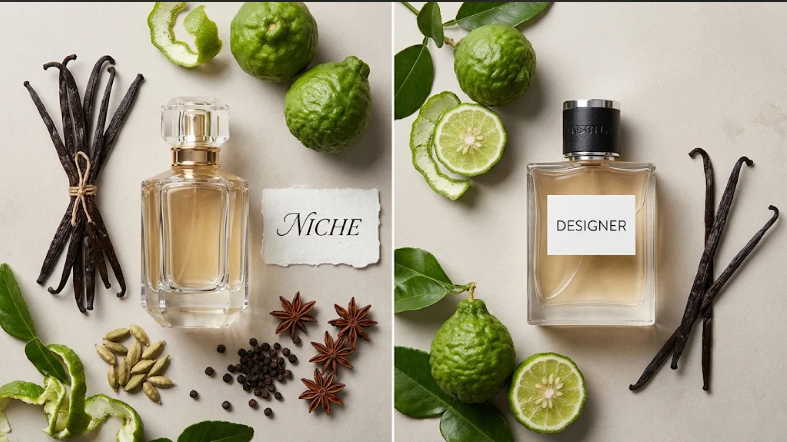
Anyone who cares about clothes eventually faces the same decision. Do you buy from the big, familiar fashion houses, or do you seek out smaller, independent labels that do things a little differently? Fragrance has exactly the same split. On one side, you have designer perfumes from the names everyone knows. On the other, a growing world of niche houses that treat scent as the whole point.
Neither side is better in every case. The right choice depends on your taste, your budget, and how much you enjoy the hunt. Here’s a plain-English guide to the difference, with some practical tips for choosing.
What “Designer” and “Niche” Actually Mean
These labels get used loosely, and neither has a legal definition, so treat them as rough categories.
Designer fragrances usually come from fashion houses and luxury brands best known for clothing, handbags, or accessories. They’re typically produced under license or in partnership with large fragrance manufacturers, sold widely through department stores and big retailers, and marketed with major campaigns. Think of the fragrance counter in any large shop.
Niche fragrances come from houses that focus mainly or entirely on perfume. They tend to be distributed more selectively, sold through specialty boutiques, independent retailers, and their own stores, and often made in smaller quantities. The creative emphasis is usually on the composition itself, sometimes with unusual ingredients or concepts that mass-market launches wouldn’t risk.
Houses often cited as niche include Byredo, Le Labo, Maison Francis Kurkdjian, and Frederic Malle, while Chanel and Dior are the sort of names people call designer. The line can blur, though. Some fashion houses run prestige collections that behave like niche lines, and some niche brands have grown large enough to be widely available.
How They Tend to Differ
These are generalizations, not rules, but they help set expectations.
| Designer | Niche | |
| Availability | Easy to find and test almost anywhere | Often limited to specialty shops or online |
| Style | Broadly appealing, crowd-pleasing | More distinctive, sometimes polarizing |
| Price | Often moderate to high | Often higher, though not always |
| Exclusivity | You’ll smell it on others fairly often | Less likely to be recognized by strangers |
| Range | Strong classics and reliable bestsellers | More experimental concepts and unusual notes |
Price deserves a caution. A higher price doesn’t automatically mean a better fragrance, and plenty of well-made designer scents are excellent value. Judge by how it smells on you and how it wears, not by the label.
Which One Suits Your Style?
Fashion offers a useful comparison.
If you like building a wardrobe from reliable, well-known pieces that always work, designer fragrances are the equivalent. They’re tried, widely loved, and easy to wear in most settings. A classic designer scent is the fragrance version of a good trench coat.
If you prefer independent labels, vintage finds, and pieces nobody else is wearing, you’ll probably enjoy exploring niche houses. The payoff is a scent that feels more personal and less common. The trade-off is the effort: you’ll spend more time sampling, and you’ll often pay more.
Many people mix both. A dependable designer scent for everyday wear, plus one niche bottle for evenings or special occasions, mirrors how most people actually dress.
When a Small-Batch Favorite Disappears
Here’s something worth knowing before you fall in love. Fragrances get discontinued, and smaller houses sometimes have fewer resources to keep every scent in production. Ingredients become scarce or expensive, regulations change what can be used, and brands streamline their lineups. The upshot is that a scent you adore can vanish, and the more unusual the fragrance, the harder it can be to replace with something similar.
If that happens, there are options beyond hunting through marketplace listings with unclear storage histories. Some specialists, such as Fragrance Revival, focus on recreating discontinued scents. For fans of niche fragrances who’ve lost a favorite, that can be a more promising route than gambling on an old bottle. It’s worth approaching it with realistic expectations, since a recreation is an interpretation and may not match the original exactly, but it can bring you close to something you thought was gone.
A simple precaution: when you find a scent you truly love, write down its name, house, and notes, and consider buying a backup bottle.
How to Shop Smartly in Either Category
A few habits make the process easier and cheaper.
Sample before you buy. Fragrance reacts differently on every skin. Ask for samples, or look for discovery sets that let you try several scents for a modest cost. Niche houses and specialty retailers often offer them.
Test on skin and wait. Spray a small amount on your wrist, then give it several hours. The opening notes fade quickly, and the dry-down tells you what you’ll really be wearing.
Learn the notes. Reading the list of notes helps you spot patterns in what you enjoy, such as woods, florals, or citrus, which narrows your search.
Be wary of unusually cheap deals. Fragrance, especially in the niche world, is a target for counterfeits. Buy from authorized sellers or the brand directly, and be skeptical of prices that seem too good to be true.
Consider decants carefully. Small decanted samples are a popular way to try expensive scents, but make sure the seller is reputable, since authenticity and storage can vary.
Think About Longevity and Care
Whichever route you choose, store your fragrance properly. Heat, light, and humidity break down perfume over time, so keep bottles in a cool, dark, dry place with the cap on. A well-stored bottle keeps its character for years, while one left on a bathroom shelf can turn within months.
It also helps to remember that concentration, not category, affects how long a scent lasts. An eau de parfum generally lasts longer than an eau de toilette, whether the bottle is designer or niche.
Questions to Ask Before You Commit
Before buying a full bottle, run through a short checklist.
- Have I worn this on my skin for several hours?
- Do I still like it after the opening has faded?
- Would I wear this regularly, or only on rare occasions?
- Does the price fit my budget without regret?
- Am I buying from an authorized or trustworthy source?
If most of the answers are yes, you’re in good shape.
The Bottom Line
Designer and niche fragrances are two paths to the same destination: a scent that feels like you. Designer options offer reliability and easy access, while niche houses offer individuality and the thrill of discovery. Try both, sample generously, trust your own nose over any label, and take care of the bottles you love. And if a favorite ever disappears, remember that there are now ways to bring it back.